AI vs Traditional Video Production for Advertising | Brand Strategy Guide (2026)
Brands spent decades accepting the reality of video advertising: it was expensive, slow, and logistically brutal. A single 30-second TV spot could cost $200,000 and take eight weeks from brief to broadcast. Social video was cheaper, but even a modest product ad required a crew, a location, a shoot day, and a post-production pipeline that stretched weeks.
That reality has fundamentally shifted. AI video production for advertising has matured from a novelty into a legitimate production pathway — one that major brands, fast-growing DTC companies, and performance marketers are actively choosing over traditional methods.
But this isn't a story where one approach simply replaces the other. The brands getting the best results in 2026 are the ones who understand exactly when AI video outperforms traditional production, when traditional still earns its higher price tag, and how to combine both into a strategy that's built around outcomes rather than habit.
This guide breaks all of it down — with data, real trade-offs, and a framework for making the right call.
TL;DR: AI video production cuts costs by 80–95% and shrinks timelines from weeks to days. It excels at social ad creative, A/B testing, localization, and high-volume campaigns. Traditional production still leads for brand films, testimonials, and high-emotion storytelling. The winning 2026 strategy combines both — and choosing the right AI production partner (not a DIY tool) is what separates forgettable AI video from work that converts.
What the Data Actually Says About AI Video in 2026
The adoption numbers are striking. According to IAB research, 86% of buyers are already using or planning to use generative AI to build video ad creative. AI-generated video ads now represent roughly 30% of all digital video ads — a figure projected to reach 40% by the end of 2026.
The AI video generation market itself is on track to reach $18.6 billion globally by end of 2026, growing at a compound annual rate of 34.2% between 2023 and 2028.
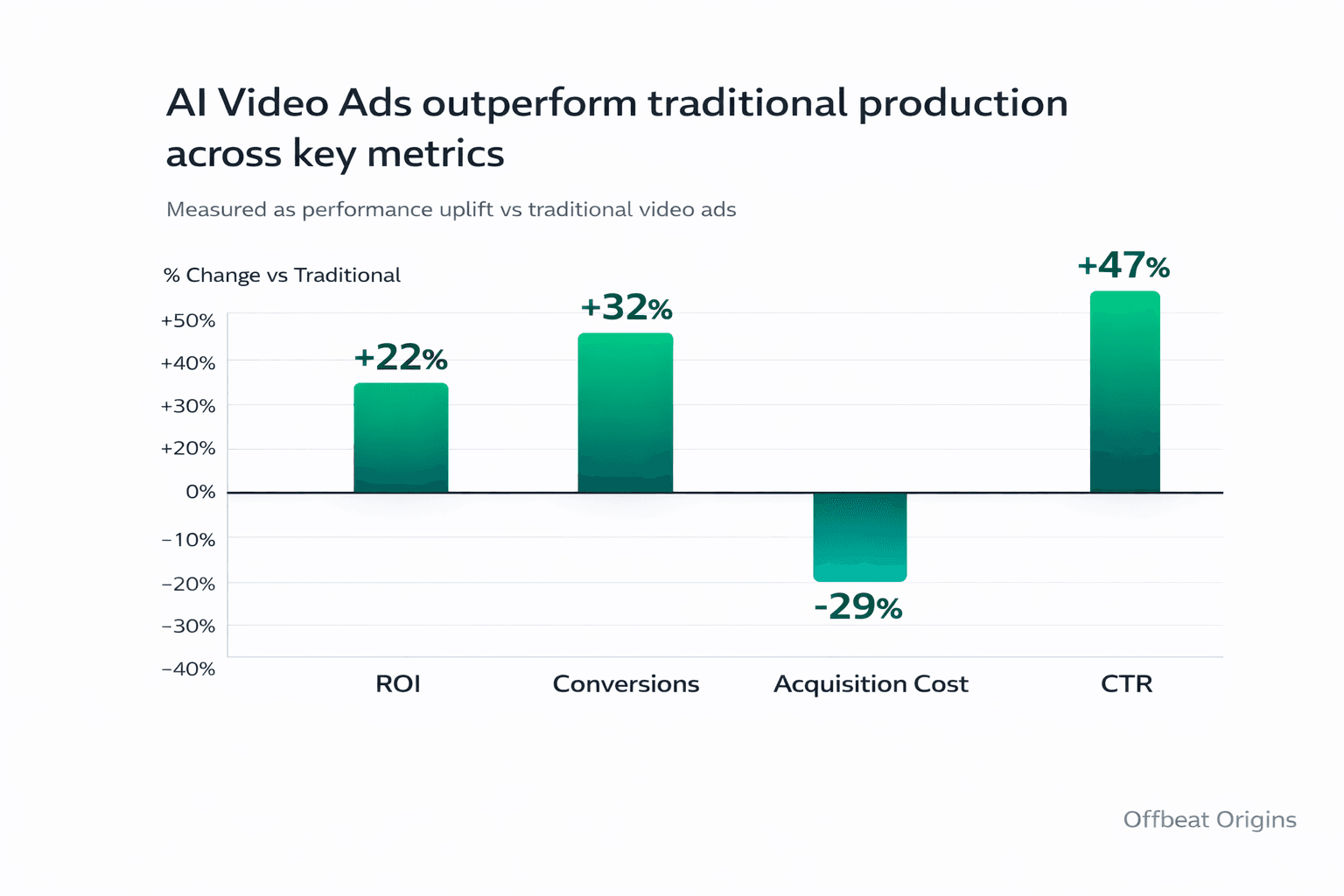
But the most important data point for brand marketers isn't the market size — it's performance. AI-driven video campaigns have been shown to deliver 22% higher ROI, 32% more conversions, and 29% lower customer acquisition costs compared to traditionally produced creative, according to analysis compiled from multiple performance marketing studies. AI-generated ad creatives also increase click-through rates by an average of 47% versus traditionally produced ads.
These aren't marginal improvements. They're category-level shifts in what's possible for advertising budgets.
The Real Cost Comparison: AI vs Traditional Video Production
Cost is where the AI vs traditional conversation usually starts. The gap is significant enough to reframe how brands think about production budgets entirely.
Traditional Video Production Cost Breakdown
Traditional production costs vary widely by project scope, but the ranges are well-established across the industry:
Simple corporate or social video: $1,200–$5,000 per finished minute
Professional brand commercial: $5,000–$20,000 per finished minute
High-production TV or OTT spot: $15,000–$50,000+ per finished minute
Full campaign with concept, crew, location, talent, and post: $50,000–$250,000+
These costs reflect real line items: pre-production planning, director and crew fees, location permits and scouting, on-camera talent, lighting and equipment rental, shoot days, and the post-production pipeline (editing, colour grading, sound design, motion graphics, revisions).
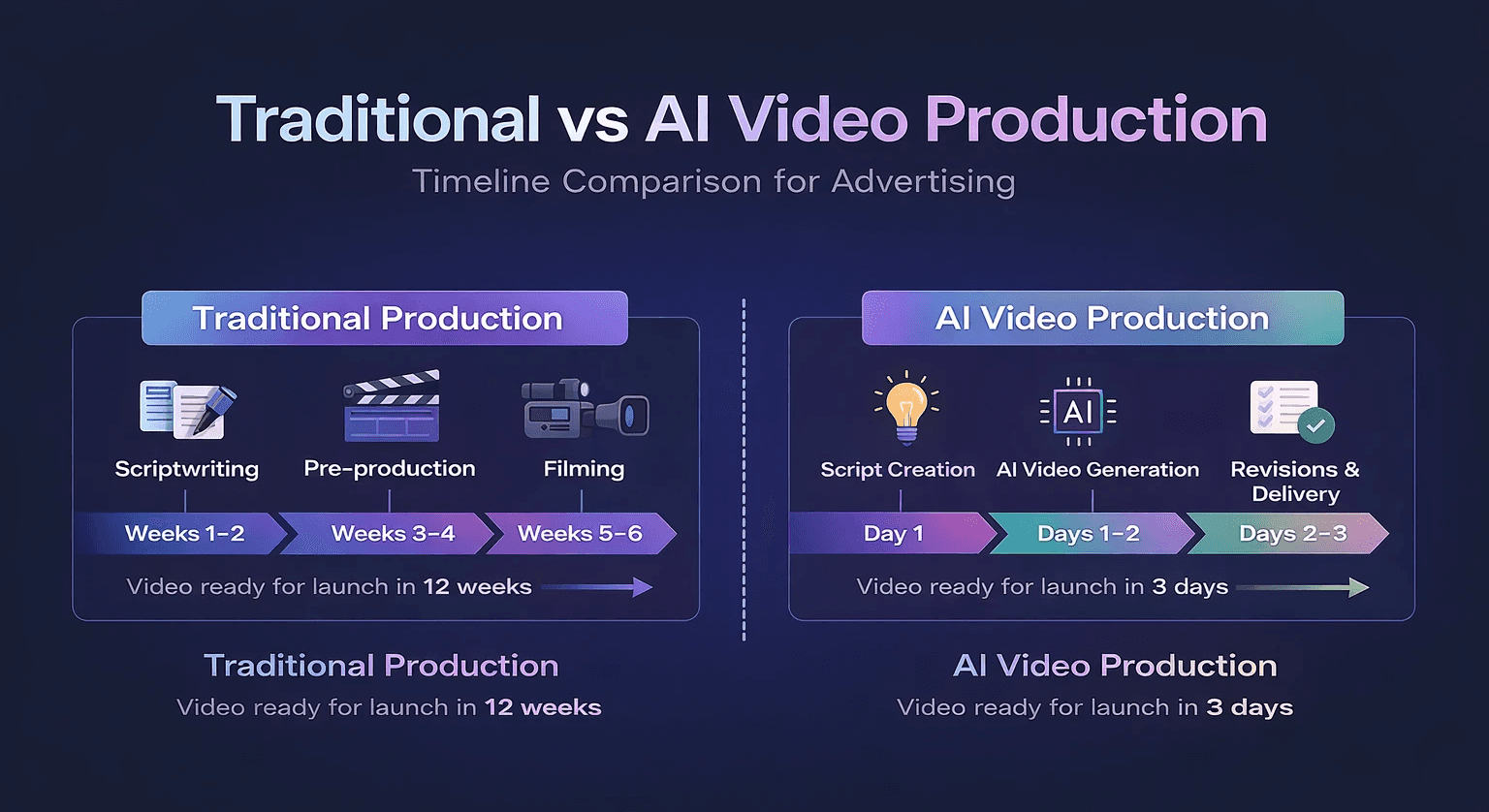
A 13-week turnaround from brief to broadcast-ready master is not unusual for mid-tier traditional production. Four to eight weeks is considered a standard timeline.
AI Video Production Cost Breakdown
AI video production operates on an entirely different cost structure:
AI video generation tools: $20–$150/month for platform access
Per-video cost for a 60-second ad: $5–$400 depending on complexity and approach
Full campaign (10 video variants): $89–$2,000 using AI production workflows
Professional AI video agency (full service): Significantly less than equivalent traditional production, with dramatically faster delivery
The production timeline collapses equally. Using current AI production tools, a 60-second marketing video that previously required 13 days now averages 27 minutes of generation time. Full campaign production — including multiple variants, formats, and language versions — regularly completes in 2–3 days rather than 2–3 months.
A concrete example from 2025 illustrates the scale of the shift: a prediction market platform needed a broadcast-quality commercial for the NBA Finals on short notice. Using Google Veo 3 and a suite of AI production tools, the team delivered a broadcast-ready commercial in two days for approximately $2,000. The equivalent traditionally produced spot would have cost $200,000+ and taken six to eight weeks.
Traditional Production | AI Video Production | |
|---|---|---|
Cost per finished minute | $1,200–$50,000+ | $0.50–$400 |
Campaign of 10 videos | $50,000–$250,000+ | $89–$5,000 |
Turnaround time | 4–12 weeks | Hours to 3 days |
Revision cycles | Limited (expensive) | Unlimited (fast) |
Multilingual versions | Full re-production cost | Near-zero marginal cost |
A/B test variants | Cost-prohibitive | Standard workflow |
Quality and Consumer Perception: The Honest Picture
The cost and speed advantages are real, but smart brands ask the harder question: does quality hold up? And how do consumers respond?
When Viewers Can't Tell the Difference
The quality gap between well-produced AI video and traditional production has closed dramatically. In blind testing studies, 73% of viewers cannot distinguish high-quality AI-assisted video from traditionally filmed content. For performance advertising — where the goal is clicks, conversions, and attention — this near-parity matters more than the production method.
AI generation capabilities have effectively reached parity across leading platforms, which means the competitive advantage has shifted. In 2026, the differentiation isn't what AI can generate — it's how effectively creative direction shapes what AI produces. Brands working with skilled AI production teams consistently outperform brands using the same tools with generic prompts.
The Authenticity Problem (and When It Actually Matters)
There is a real caveat here, and honest brands need to account for it. Consumer sentiment — particularly among Gen Z audiences — has grown more negative toward AI-generated advertising, even as adoption among advertisers has increased. The IAB calls this the "AI Ad Gap": the widening distance between advertiser enthusiasm and consumer skepticism.
The risk is highest in specific content types:
Customer testimonials: If viewers suspect a testimonial is AI-generated, trust erodes completely. The entire value of a testimonial is its authenticity — AI undermines that value proposition.
Executive communications: When a brand's leadership appears on camera, audiences are calibrated to detect artificiality. AI avatars in this context often land in uncanny valley territory.
High-emotion brand moments: Brand films designed to move audiences — anniversary spots, cause-related campaigns, cultural statements — derive their power from genuine human presence. AI generates visual information; it doesn't generate felt emotion.
Regulated industries: Pharma, financial services, and legal sectors often require demonstrable authenticity in on-camera claims. AI-generated content introduces compliance risk alongside perception risk.
In practice: if authenticity is the product being sold, traditional production isn't just preferable — it's load-bearing. No amount of production efficiency justifies undermining the core message.
Where AI Video Production Outperforms Traditional
For a large and growing category of advertising needs, AI production isn't a compromise — it's the strategically superior choice.
High-Volume Social Ad Creative
Social advertising runs on volume. Effective performance marketing on Meta, TikTok, YouTube, and connected TV requires constant creative refresh — new hooks, new formats, new iterations as creative fatigue sets in. Traditional production economics make this volume impossible for most brands.
AI production removes the ceiling. Brands that previously ran three to five creative variants per campaign can now run 30 to 50, testing hooks, calls-to-action, visual styles, and messaging angles simultaneously. The best-performing variants get scaled; underperformers are replaced within days, not months.
Companies using AI video production report creating five to ten times more content with the same budget — a multiplier that directly impacts the ability to find winning creative before ad spend is wasted.
Rapid Concept Testing and Creative Iteration
Traditional production creates a structural problem for creative risk: the cost of a shot concept being wrong is too high, so brands default to safe choices. AI inverts this dynamic. When producing a test variant costs $50 instead of $5,000, brands can afford to be genuinely experimental.
This matters for performance. The creative ideas most likely to break through are rarely the safe ones — they're the unexpected angles, the unconventional formats, the hooks that wouldn't survive a traditional pre-production process. AI production makes genuine creative risk affordable.
Localization and Multilingual Campaigns
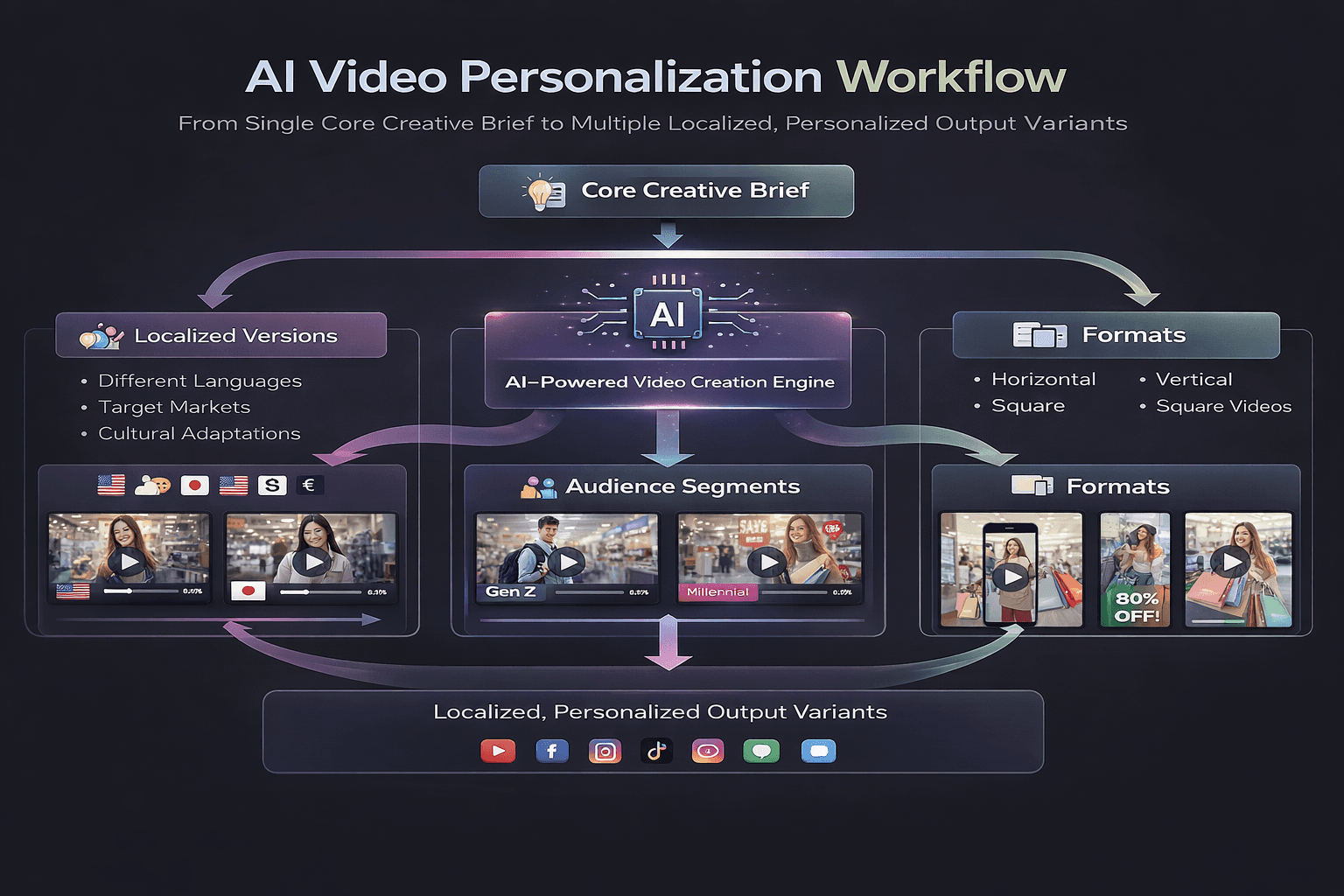
Global advertising has always involved a painful trade-off: either re-produce content for each market (expensive) or run the same English-language creative everywhere (ineffective). AI collapses this trade-off.
With AI video production, brands can generate market-specific versions with adapted visuals, dubbed audio, on-screen text, and culturally relevant cues at near-zero marginal cost per additional market. Trivago and similar global brands now run localized ad variants across dozens of markets from a single core production. Virgin Voyages used AI-personalized video to generate individualized invitations at scale — content that would have been logistically impossible with traditional methods.
Personalization at Scale
One-to-one video personalization — once reserved for experimental campaigns with massive budgets — is now operationally viable with AI. Brands can generate video variants personalized to a viewer's name, location, browsing behavior, purchase history, or segment with minimal added production cost. Personalized AI-driven video campaigns report up to 35% higher open rates and significant click-through improvements over non-personalized equivalents.
Where Traditional Production Still Wins
The case for AI video production is strong — but it's not universal. Traditional production still delivers something AI currently cannot replicate.
Hero Brand Films and Flagship Campaigns
There are campaigns where the production is the message. When Apple releases a product film, the cinematic quality, the direction, the carefully choreographed emotion — these are not incidental features. They are the brand positioning made visible. A brand operating at this level of intent requires craft that traditional production, with its human directors, cinematographers, and editors, is specifically designed to deliver.
The same logic applies to any campaign where the brand is making a statement about who it is, not just what it sells. Heritage brands, premium positioning, cultural moments — these call for traditional production because the investment itself signals something.
Testimonials and Real Customer Stories
Authentic human testimony is one of advertising's most durable conversion drivers, precisely because audiences know it can't be faked. (Or rather: when it is faked, they can tell, and the backlash is severe.) Real customers, on camera, speaking candidly about their experience — this is content that AI cannot generate, and attempting to simulate it with AI carries meaningful brand risk.
Regulated and High-Stakes Content
In categories where compliance, verifiability, or liability are factors — pharmaceutical advertising, financial services, legal or insurance communications — the provenance of on-camera content matters. AI-generated content introduces risk that traditional production, with documented talent releases and verifiable shoots, avoids by design.
The Hybrid AI-First Strategy: What Smart Brands Are Doing in 2026
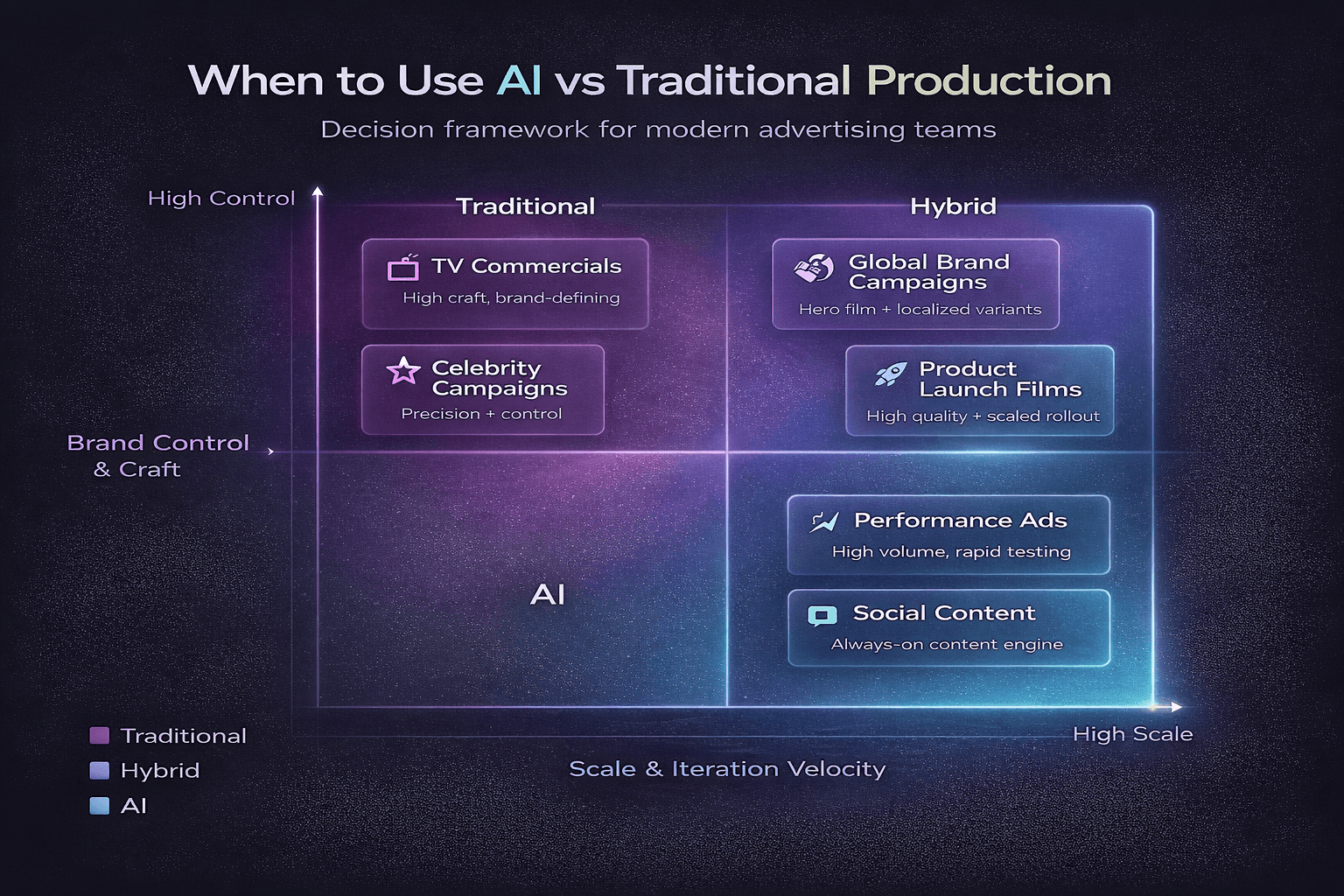
The most effective advertising operations in 2026 aren't choosing between AI and traditional production — they're using a hybrid model that assigns each approach to the work it does best.
The pattern looks like this: produce a core anchor asset with traditional methods — a hero film, a flagship testimonial series, a brand manifesto spot — where authenticity, craft, and emotional authority are non-negotiable. Then use AI production to extend that asset: social format cuts, platform-specific versions, multilingual variants, personalized derivatives, and ongoing iteration for performance campaigns.
The original footage provides the creative authority. AI production provides the scalability.
This approach reduces overall production costs significantly compared to running traditional production for every asset, while preserving quality where it genuinely drives brand equity. Organizations blending human creative direction with AI production are delivering broadcast-quality work in as little as 24 hours on derivative content, while maintaining the brand consistency that full traditional production builds.
The decision framework for any given campaign:
Is authenticity the core value being delivered? → Traditional
Is volume, speed, or iteration the primary need? → AI
Does the content require real human presence (testimonials, executive comms, high-emotion storytelling)? → Traditional
Will multiple formats, markets, or variants be needed? → AI
Is this a flagship brand moment? → Traditional (with AI for distribution formats)
Is this performance creative designed to test and scale? → AI
How to Choose the Right AI Video Production Partner
There's an important distinction the industry doesn't always make clearly: AI video tools and AI video production are not the same thing.
Subscribing to an AI generation platform gives you access to capabilities. It doesn't give you creative direction, strategic brief development, performance creative expertise, or the production judgment to know which prompts, styles, and structures are going to work for your audience. This is why brands who use DIY AI tools often produce content that looks technically competent but fails to convert — the tool was there, but the creative thinking wasn't.
Working with an AI-first production partner means getting the cost and speed advantages of AI generation alongside the strategic and creative expertise that separates effective advertising from filler content. When evaluating an AI video production partner, the right questions are:
What is their track record with performance advertising, not just production?
How do they approach creative brief development and concept strategy before touching any tool?
Can they demonstrate output quality across different ad formats and platforms?
How do they handle iteration — and at what speed?
Do they understand your category well enough to avoid the brand risk pitfalls specific to your audience?
The technology is increasingly accessible. Creative judgment is not.
Frequently Asked Questions
Is AI-generated video good enough for TV and OTT advertising?
Yes, in many cases. High-quality AI production has cleared the technical bar for broadcast and streaming platforms. Whether it's the right choice depends on the campaign's creative brief — specifically, whether authenticity and cinematic craft are central to the message.
How much does AI video production cost compared to traditional?
Traditional professional video runs $1,200–$50,000+ per finished minute. AI production workflows bring this to $5–$400 per finished minute, with full campaigns that previously cost $100,000+ now deliverable for $2,000–$10,000. The savings widen further as campaign volume increases.
Will audiences know my ad was made with AI?
In blind tests, 73% of viewers cannot distinguish high-quality AI video from traditional production. The risk isn't quality detection — it's context detection. Audiences are more skeptical when AI is used in content types that signal authenticity (testimonials, real people, personal moments). Used in appropriate contexts, AI video is effectively indistinguishable.
Can AI video handle multiple languages and markets?
This is one of AI's clearest advantages over traditional production. AI can generate multilingual versions — including dubbed audio with synchronized lip movement, adapted on-screen text, and culturally specific visual adjustments — at near-zero marginal cost per additional market.
What is the typical turnaround time for AI video production?
Simple ad variants and social formats: hours to same-day. Full campaign suites with multiple formats, languages, and iterations: 2–5 business days. This compares to 4–12 weeks for equivalent traditional production.
Does AI video production work for B2B advertising?
Yes, and it's particularly well-suited for B2B performance creative where volume and iteration matter. Product demos, explainer videos, and account-based personalization are high-value use cases. Traditional production remains relevant for B2B brand films and executive-led content.
The Bottom Line
The question for 2026 isn't whether AI video production belongs in your advertising strategy — the performance data, cost economics, and adoption rates have already answered that. The real questions are which campaigns benefit most from AI production, where traditional production still justifies its premium, and whether you're working with a production partner who can make AI-generated creative genuinely work at the level your brand requires.
AI has changed the economics of video advertising permanently. Brands that adapt their production strategy to reflect that reality — rather than defaulting to traditional workflows out of habit or hesitation — will have a meaningful structural advantage in both output volume and budget efficiency.
If you're evaluating whether AI video production is the right fit for your next campaign, the best starting point is a direct conversation about your specific brief, goals, and audience. The strategy should lead the tools — not the other way around.
Offbeat Origins is an AI video production agency helping brands create high-performance advertising creative at scale. Get in touch to discuss your next campaign.

Reading Time
5 min